
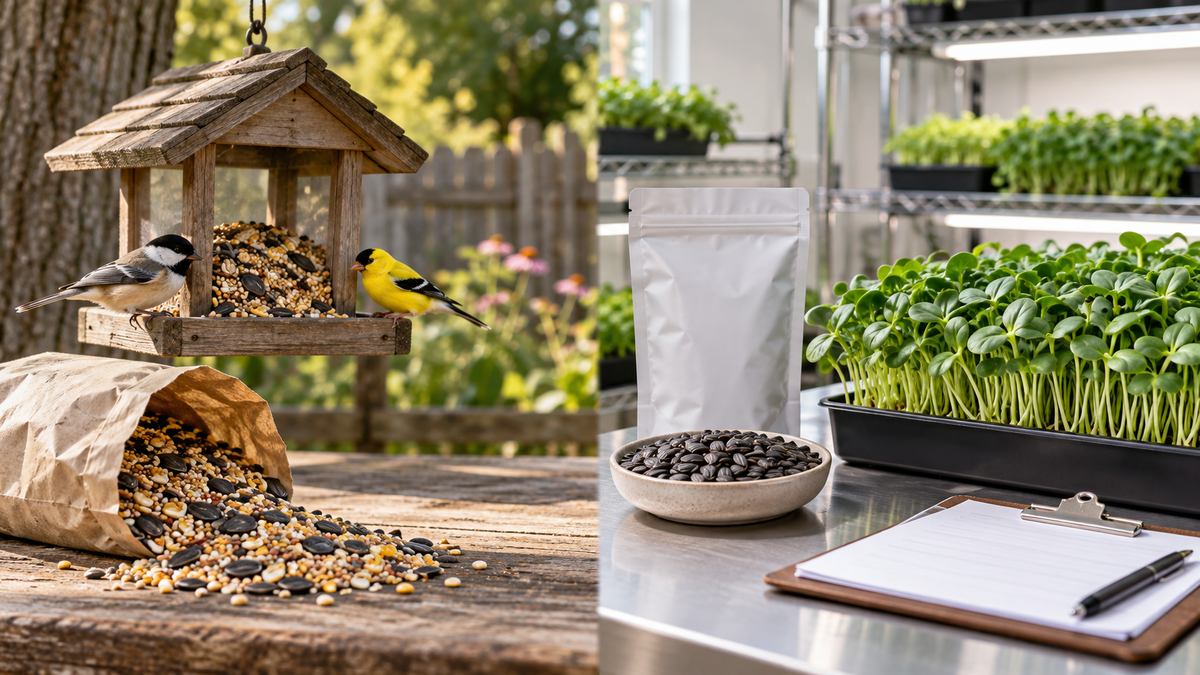
Birdseed vs. Microgreen Seed: Why Birdseed Should Not Be Used to Grow Food
At first glance, a bag of birdseed may look like an inexpensive source of sunflower, millet, peas, or other seeds. That similarity can tempt new growers to ask a reasonable question: If the seed sprouts, why not use it to grow microgreens?
The answer is simple and important: birdseed is manufactured, labeled, and sold as food for animals. It is not being represented as seed selected and handled for producing a crop that people will eat. A product intended for birds should not be repurposed as an ingredient in human food production.
That distinction matters for home growers, and it is especially important for commercial microgreen businesses responsible for the products they sell.
Birdseed Is Animal Food
The U.S. Food and Drug Administration defines animal food as food made for animals. Animal food must be safe for its intended animal use, produced under applicable requirements, and truthfully labeled. Those requirements do not transform an animal-food product into a human-food ingredient.
If a package is labeled “not for human consumption,” “for wild birds,” or otherwise identifies an animal use, growers should take that direction seriously. Sprouting the contents does not change the product’s original intended use or establish that it was sourced and handled for human food production.
This does not mean every individual seed in every birdseed bag is automatically poisonous. It means the product is being offered for a different purpose, under a different supply chain and set of expectations. A grower should not infer human-food suitability from appearance alone.
Microgreen Seed Provides Identity and Traceability
A professional grower needs to know what was planted. Properly labeled agricultural or vegetable seed can provide information such as crop or variety identity, purity, germination, lot number, supplier, and treatment disclosures when applicable. The Federal Seed Act functions as a truth-in-labeling law for agricultural and vegetable seed shipped in interstate commerce.
Birdseed mixes are formulated to feed birds, not to produce a uniform crop. A mix may contain several species, broken seed, hulls, grain, oilseed, or other components in proportions chosen for animal feeding. Even a single-ingredient bird food may not provide the production information a microgreen grower needs.
Without dependable identity and lot traceability, it becomes difficult to investigate weak germination, uneven growth, an unexpected plant, a customer complaint, or a recall. For a commercial farm, that is an operational and food-safety problem—not merely an inconvenience.
Similar Appearance Does Not Mean Equivalent Handling
Two bags may both contain black sunflower seed, yet their intended uses can be completely different. Seed appearance cannot tell you how a lot was stored, cleaned, transported, tested, or protected from contamination.
Animal food and human food are both regulated, but they are not interchangeable categories. FDA guidance recognizes that material acceptable for animal food may sometimes be unsuitable for human food because the intended uses and quality considerations differ.
Microgreens are typically eaten fresh and may receive little or no cooking before consumption. That makes responsible sourcing, sanitation, environmental control, traceability, and crop handling especially important.
Birdseed May Perform Poorly as a Crop
Even apart from food-safety concerns, birdseed may create disappointing growing results. Mixed species can germinate at different speeds, reach different heights, and require different amounts of water. Broken or poorly stored seed may germinate inconsistently. Unknown varieties make it difficult to establish a reliable seeding rate, harvest schedule, flavor, or yield.
Commercial growers need uniform trays. A dependable crop supports predictable harvests, consistent packaging, accurate pricing, and reliable delivery. Saving money on the initial seed purchase can become expensive when labor, tray space, media, and customer commitments are lost to an inconsistent crop.
Pathogen Testing Provides Meaningful Information
Choosing seed sold for microgreen production is an essential sourcing decision. Greener Harvest Seed Co. carries seed lots that have undergone pathogen testing, giving growers meaningful lot-specific information that ordinary birdseed does not provide.
Pathogen testing is valuable, but it should be described accurately. A result applies to the sample and lot tested; it does not mean seed is sterile or eliminate the need for careful handling. Growers should maintain lot records, inspect seed when it arrives, store it correctly, and test new lots under controlled growing conditions. Commercial operations should also follow applicable food-safety requirements and documented sanitation, water, employee hygiene, environmental, harvest, packaging, and recall procedures.
The right message is not that tested microgreen seed can never have a problem. The accurate message is that purpose-selected, traceable seed supported by lot-specific testing gives a grower a far more appropriate and informed starting point than animal feed.
What About Seed Treatments?
Seed treatments are another reason labels matter. The Federal Seed Act requires chemical seed treatments to be disclosed when present. Seed treated with certain substances may carry specific caution statements or restrictions.
Never plant treated seed for microgreens unless the treatment is explicitly appropriate for the intended crop and use. Do not assume washing, soaking, or growing will remove a treatment or make unsuitable seed acceptable for food production.
Likewise, do not claim that all birdseed is chemically treated. The accurate point is that growers must know exactly what they are buying, read the label, and use seed only for its represented purpose.
The Risk to a Microgreen Business
Using birdseed can put more than one crop at risk. If a buyer learns that greens were produced from seed labeled as animal food, trust can disappear quickly. Restaurants, retailers, distributors, insurers, regulators, and customers may reasonably ask why a commercial food producer selected an input not represented for that use.
A low seed price cannot compensate for a rejected order, inconsistent product, damaged reputation, or inability to trace a lot. Professional growers should be able to show what they planted, where it came from, which lot was used, and how it moved through production.
What Growers Should Buy Instead
Choose clearly identified seed offered for growing, with available variety and lot information. Look for a supplier that understands microgreen production, communicates germination and available pathogen-testing information, maintains traceability, and can answer questions about sourcing and documentation.
Before placing a new lot into full production:
-
Review the product label and intended use.
-
Record the supplier, variety, lot number, and received quantity.
-
Inspect the packaging and seed condition.
-
Retain available documentation.
-
Run a small germination or production trial.
-
Track seeding rate, environment, crop time, uniformity, and usable yield.
-
Keep the lot connected to finished production records.
The Bottom Line
Birdseed is made and marketed as animal food. Microgreens are grown as food for people. The fact that birdseed may sprout does not make it an appropriate input for human food production.
Use seed for its intended purpose. For microgreens, choose properly identified, traceable seed from a supplier serving growers, and combine that sourcing decision with strong sanitation and food-safety practices. Your customers trust you to make responsible choices before the first seed ever reaches a tray.
Suggested source links
-
FDA, Animal Food Regulations: https://www.fda.gov/animal-veterinary/animal-health-literacy/animal-food-regulations
-
USDA Agricultural Marketing Service, Federal Seed Act: https://www.ams.usda.gov/rules-regulations/fsa
-
USDA Agricultural Marketing Service, Labeling Requirements for Chemically Treated Seed: https://www.ams.usda.gov/sites/default/files/media/LabelingRequirementsforChemicallyTreatedSeed.pdf